Mr. Chen runs a branded clothing business in Shenzhen. Previously, the labels for his clothing were woven labels. He places great importance on the overall comfort of the clothing and has always disliked computer-cut woven labels, feeling they aren’t comfortable enough.
The current ultrasonic cutting technology has improved a lot compared to the earliest hot knife cutting and has been increasingly accepted by top international brands. For example, not long ago we made ultrasonic-cut labels for the international luxury brand Loewe.
But this particular client is very persistent and does everything possible to enhance the customer experience.
Solving the problem of computer-cut labels being prickly is actually quite simple. They can be made using a crochet machine or a wooden shuttle weaving machine, but he believes the latter cannot match the precision of computer-cut labels, which is certainly true. Every type of equipment and process has its own significance and advantages.
When the ceiling of woven labels has been reached, the only option is to try wash care label which led to the conversation in the screenshot.
Honestly, I’m especially happy when clients do such tests. I hope we get more clients like this. The more tests and requirements a client has, the more we can examine and refine the quality of our wash care label factory.
Mr. Chen is also very straightforward. He sent samples of wash care label materials and process prototypes twice according to his requirements. After locking in the materials, he didn’t immediately ask us to produce samples according to their documents. Instead, he first used the materials he selected and randomly printed content on whichever equipment was available to test the washing process. Only after passing the washing test did he request samples according to the correct documents.
An ideal client is like this: not only quick to pay and uncomplicated, but also able to think from another’s perspective.
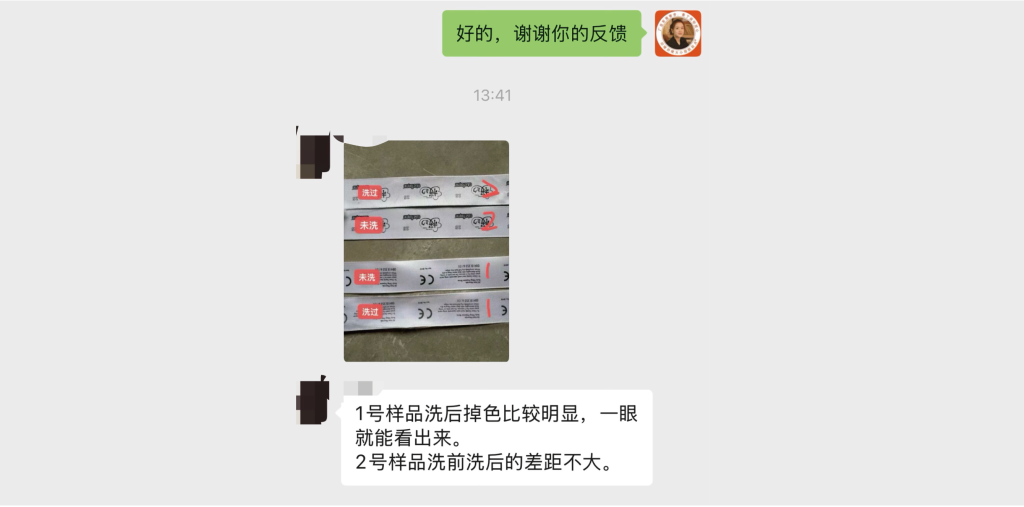
For the first batch of wash care label samples, we used two different types of equipment, the same ink, and the same material for printing. The final wash care label Sample 2 has now reliably withstood 30 machine washes with minimal difference before and after testing, which is difficult for competitors to surpass. Next, we will continue testing the effect of 50 machine washes.
This is a very good result and has greatly increased my confidence.
I had previously been thinking about where we could make breakthroughs in producing fabric label, and this presents a very good opportunity. I plan to later use our two commonly used inks, print the finished product, and then perform washing tests using different processes and raw materials.
Having real data makes it easier to communicate with clients confidently and provide better, more professional advice.
Running a label manufacturer requires thinking for yourself; you can’t just be a robot that knows how to produce. If you don’t think, you will eventually be crushed by competitors and dragged into a bottomless price war.
Today, the second batch of samples is being made, using a single-sided woven-edge ribbon. Streetwear brands like to be creative, using the reverse side for the front printing.
This is a common technique among many streetwear brands; Marvel does it too. We’ve only done Marvel’s toy series so far; we haven’t yet found clients for Marvel clothing.
They really should come to me. The wash care labels on Marvel clothing are printed rather poorly, with serious ghosting. Our wash care label samples are almost flawless, which is very difficult for competitors to achieve.
Once you produce printed labels at Jiachen, you won’t need to try your luck with another factory.