My phone battery lasts longer and longer these days. One charge now easily lasts two or three days.
It’s not that batteries have improved. It’s that I barely get a chance to pick up my phone — except when talking to customers. Sometimes I even miss replying to their messages in time. I’ve been desperately needing to free myself from the workshop floor.
Today, I finally see the light. The factory is almost fully staffed, and we’ve found the right person for the critical label-cutting position — a young lady born in 1999. I just need to spend some time training her well. Finally, I no longer have to hunch over the cold-cut machine, grinding out label after label every single day for production targets.
Don’t get me wrong — this job may look simple, but it takes someone quick-minded and adaptable. Last night, we were cutting a tear-away care label. The material was extremely thin with a bit of stretch. I originally thought the printing stage would be the difficult part, prone to registration shifts. I never expected cutting to be even harder.
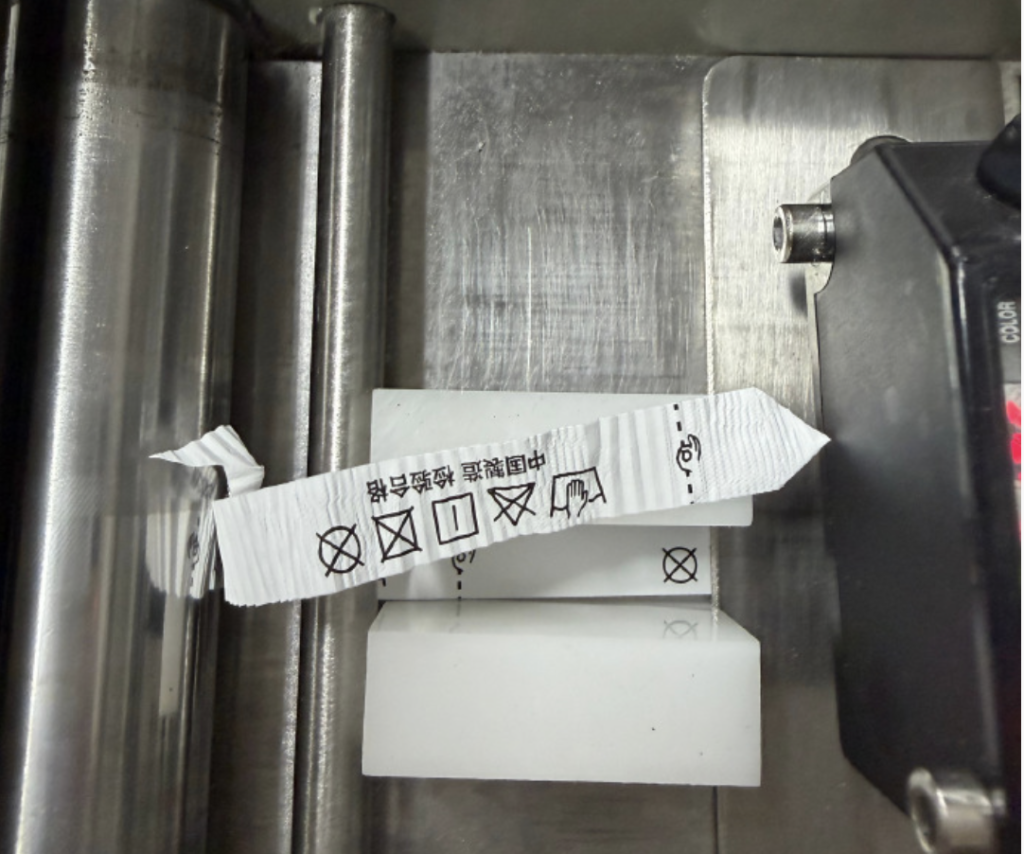
At first, I used our older cold-cut machine on this label. It simply couldn’t handle it — static electricity everywhere, the wash care labels sticking badly to the blade, and the material bunching up at the rear feeding section.
So we switched to the new cold-cut machine we bought this year. The anti-static performance was noticeably better. But a new problem appeared: the feed rollers near the blade kept wrapping material. I cleaned the blade, and my technician taught me some handling tricks — spraying water at regular intervals on both the front and rear rollers to keep them moist.
Even with all this, material jams barely improved. I started troubleshooting — could it be the speed? And I made a small discovery: for this kind of blade-sticking material, you can actually raise the speed by a gear or two. Since the material was so thin, I also tried adding a bit more pressure at the feed inlet.
After all this trial and error, we still get occasional jams at the front end, but production can finally move along fairly smoothly.
As for orders using this kind of wash care label material — the material cost isn’t high, so it looks like you’re saving money, but the labor time cost in production is much higher. Going forward, I’ll advise customers to avoid this type of tear-away tape whenever possible. And if they insist on using it — good luck finding a second care label factory that can keep quality under control with this material.
While cutting, I had our new cutting operator sit beside me and showed her exactly what to watch for:
1.Check the cut position frequently — both ends must form perfect right angles.
2.For labels like this one that require front-to-back registration, pick out any pieces with a shift exceeding 1mm.
3.Separate out defective pieces: dirt spots, printing flaws, or designs not centered left-to-right.
We cut 40,000 labels in total. Our technician’s skill is truly impeccable — apart from the common issue of serious registration shifts near the beginning and end of each material roll, everything was registered beautifully.
Cutting labels should absolutely NOT be done the way many “peers” I see on TikTok do it — set the machine, let it run non-stop, hang a bag at the end, and walk away with nobody watching. That kind of production has no quality whatsoever. Printing operators are not gods — no printing process runs completely free of defects.
Got a care label that other factories can’t handle, or can’t do well? Give Ruan Qiuyue a try.
We are a Disney-certified care label factory. No need to hesitate — start with a small trial order.
———————
If you would like to know more about Ruan Qiuyue, you can follow her Facebook account