Many people say that as the future successor of the wash care label factory, I don’t need to learn everything—I just need to handle the sales side of things well.
But how can I handle sales effectively if I don’t understand the product? Ruan Qiuyue refuses to take that approach.
99% of salespeople are ignorant in five key areas:
- Raw materials and semi-finished goods
- Production processes and formulas
- Technology and patents
- Equipment and operation
- Quality inspection and control
While I can’t claim to be an expert in these five areas yet, I strive to become more professional every day. Being a “second-generation” factory owner gives me a huge advantage: I don’t have to compromise my principles or take on just any order out of desperation.
To earn more money in the future, I first need to make myself more valuable.
Yesterday was Sunday, June 14th. When you work almost every Sunday, it stops feeling like “overtime” and simply becomes a regular workday.
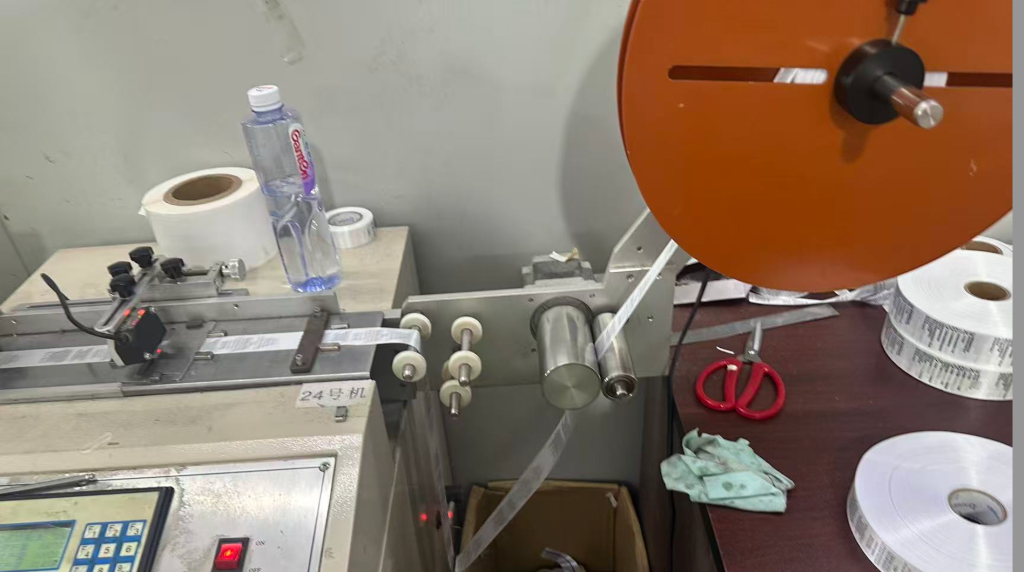
I didn’t have to come to the factory on a Sunday; there were no urgent sales tasks requiring attention. But I didn’t want to waste this prime opportunity to get hands-on experience on the shop floor.
Yesterday, I studied the “label cutting” process (cutting wash care labels).
To those who haven’t experienced it, label cutting might seem like a trivial task—something anyone with a pair of hands could do.
But label cutting is far from simple; it involves a level of skill and nuance that isn’t immediately obvious.
It’s not just manual labor; it demands keen eyesight. This step also serves a quality control function. Workers must quickly scan for and identify issues—such as material splices made during roll changes or marks indicating defective items left by the printer operator.
I’m often amazed when I see videos of competitors using a setup where a single worker oversees multiple machines simultaneously—with no dedicated operator per machine—feeding labels into a large collection bag. It’s impressive in a way; for a wash care label factory, it’s incredibly fast and saves a fortune on labor costs. But for the customer, the only real benefit is the low price.
Only a factory dedicated to high-quality wash care labels truly understands the importance of the label-cutting role.
Our cutting process is admittedly inefficient; we have to pause every two hundred labels or so. Workers must remain fully focused, coordinating their hands and eyes with the dexterity of a professional bank teller to quickly scan for defects, bundle the items, and neatly bag them.
Next, the products move to the packaging area, where quality inspectors examine each piece individually. This closed-loop process is the reason why, over the past five years, we have received virtually no customer complaints regarding defective goods.
Producing high-quality wash care labels takes time; the production speed is at least 50% slower compared to manufacturing labels without such strict quality standards.
I spent two hours this morning down on the factory floor cutting labels myself. I have come to realize that the deeper my understanding of every step in the process, the greater the benefit. For instance, a client once brought me a care label they were unhappy with; I was able to immediately pinpoint the issue and provide a solution.
That is precisely why I am so passionate about studying every single stage of production. Even though many people might not understand it, I am committed to doing what I believe is right.
I am Ruan Qiuyue. If other manufacturers can’t handle a printed label job—or can’t get it right—it’s time to give Ruan Qiuyue Label Factory a try.