At our factory, whenever a client is undecided between two or three options regarding production processes or materials during the sample development stage for clothing care labels, we don’t make them choose—we simply produce samples for all the options.
That is exactly what happened with these two wash care labels. From the samples I provided, the client selected two materials they liked: one was a double-sided woven-edge tape suitable for double-sided printing, and the other was an imported single-sided satin ribbon, which is ideal for folded care labels.
It is difficult to visualize the final result without seeing the actual product. Clients who prioritize quality are often willing to invest both time and money into refining these details.
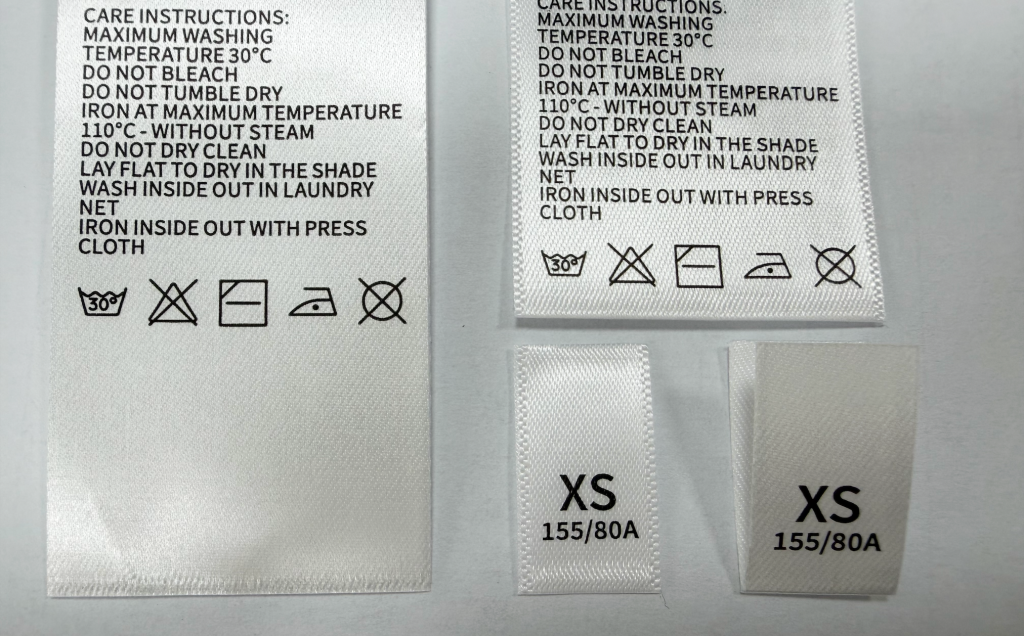
The solution is simple: we produce samples using both materials. Compared to the cost of a garment retailing for hundreds or even over a thousand yuan, this development cost is negligible.
Never underestimate the importance of material selection. Beyond the technician’s handling of the equipment and the choice of ink, material density and texture are crucial factors influencing the print quality of wash care labels.
The details of the labels we print can withstand close-up inspection—even when photographed with a smartphone and zoomed in—effectively elevating the perceived quality of the client’s product. This is a standard that many competitors struggle to match.
Of course, there are plenty of wash care labels produced without such quality standards, often using small thermal transfer (ribbon) printers. You don’t need to zoom in or look closely to spot the flaws; at a glance, the text often appears blurry or broken. Such quality really cheapens the garment.
Comparing the print results of these two materials, the imported satin label offers sharper text and superior ink adhesion.
Ultimately, the choice depends on the client’s personal preference.
For instance, brands specializing in casual streetwear or the currently trending “thug-style” aesthetic often dislike the look of high-density, refined care labels.
Instead, they prefer labels with a distinct texture—sometimes even a distressed or vintage look.
This brings me back to a point I frequently emphasize: the importance of carefully inquiring about product details and style preferences during the pre-sales phase. This allows us to propose the right wash care label solutions and streamline the development process.
Whether the wash care label order is large or small, we are always happy to work closely with clients to develop new designs.
For printed labels that other manufacturers can’t handle or fail to produce well, the only option left is to give Ruan Qiuyue Printed Label Factory a try.